
Start › Your Safari › Travel tips for Uganda › Getting Around in Uganda › Taxis, Buses and Other Means of Transport
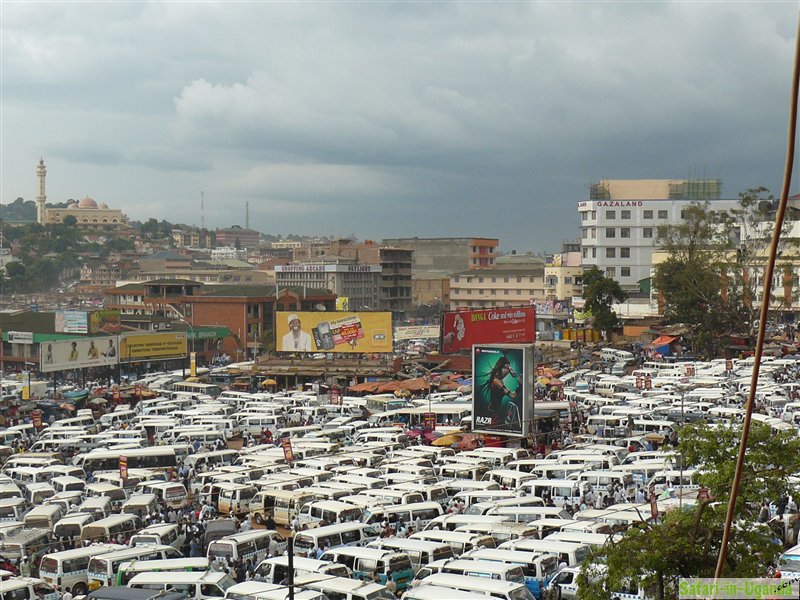 The main means of public transport in Uganda are small minibuses, which are called “taxis” here. Unlike our taxis, however, these are licensed for 14 people and very cheap. They are recognisable nationwide by their blue-checked trim. They are the main means of transport in Uganda.
How the “taxis” work
These taxis run on fixed routes, mainly through the towns and from their centres out to the outer districts. Especially in Kampala it is not entirely easy to tell which taxi goes where. The starting points in Kampala are the old and the new taxi park. What at first looks chaotic does in fact follow a system. Each taxi starts, depending on its route, at a very specific point marked by signs. If you do not know this departure point: simply ask – all Ugandans will gladly give you information.
You can stop the taxis anywhere to jump in and get out again at any time. You pay according to the distance travelled. If you travel from Kampala far outside the city, you still pay no more than 1 to 2 euros. You pay when getting out, to the conductor at the rear door. Please always carry enough small change. Tip: make your first journey with a companion who shows you how it works. After that you will have got the hang of it yourself.
Travelling by taxi is not necessarily comfortable. After all, being stuck in a minibus with 14 people in Kampala at 30° Celsius in a traffic jam can be tiring. If you want to avoid that, a “special hire” (see below) is always the better choice.
The last mile by boda-boda
There are also countless “boda-bodas“, either in the form of small motorcycles or bicycles. You as the customer ride pillion. Outside the towns, boda-bodas are used as transport for “the last mile”. After all, from the taxi stop to the front door you may have to walk a few more kilometres. Boda-bodas are well suited to such stretches. In Kampala you can also book a taxi and a boda-boda conveniently by app (e.g. Bolt and SafeBoda).
In Kampala, boda-bodas have the unbeatable advantage of speed. When traffic comes to a standstill at rush hour, you still reach your destination quickly by boda-boda.
Boda-bodas are very cheap. A single journey of 2 to 3 kilometres costs roughly 50 cents. From a safety perspective, however, you must decide for yourself whether you want to use a boda-boda. After all, helmets are compulsory but the rule is patchily enforced; with app bodas such as SafeBoda, helmets are included. And the riding style of the young riders is not always the best either.
A white person on a boda-boda?
You should know that in Uganda people are often surprised by tourists who use taxis and boda-bodas. After all, from the Ugandans’ point of view all tourists count as “rich”, so surely one could afford one’s own car. Or at least use a “special hire”. However: anyone who is not bothered by astonished glances from laughing children saves themselves a great many kilometres on foot!
Special hire: more comfort, still inexpensive
A “special hire” in Uganda is what we in Europe call a “taxi”: an ordinary car for 4 people (plus driver) that takes you to the destination you want. The drivers are usually friendly, helpful and know their way around well.
The price is not determined by the distance to the destination or the duration of the journey, but agreed in advance. Naturally, as a tourist you pay more than a Ugandan. But even so, you can be driven right across Kampala for a few euros – including insider tips from the driver, and sometimes even air conditioning.
If you are out and about on foot on the streets of Kampala, the drivers of boda-bodas or “special hires” will constantly offer you their services. This is always meant in a kind and friendly way, even on the hundredth offer. So always be friendly when declining too.
Bus travel in Uganda
All of Uganda’s towns are linked to one another by bus routes. The large coaches are preferable to the small shared taxis when it comes to safety and comfort. The post buses are particularly recommended; you can book tickets for them at any post office. They usually depart from the post office as well. Bus travel is generally inexpensive. On average you pay only 1 to 2 euros per 100 kilometres. It is best to buy your tickets the day before.
There are also international connections, for example to Nairobi (Kenya) or Kigali (Rwanda). You can find details, addresses and prices in the well-known travel guides and directly on the spot.
Rail travel
Travel by train is not possible in Uganda. There are very few rail connections at all, and these are reserved exclusively for freight traffic.