
Start › Land & People: Uganda Country Information › Uganda’s Population: Friendly and Open › Population Groups
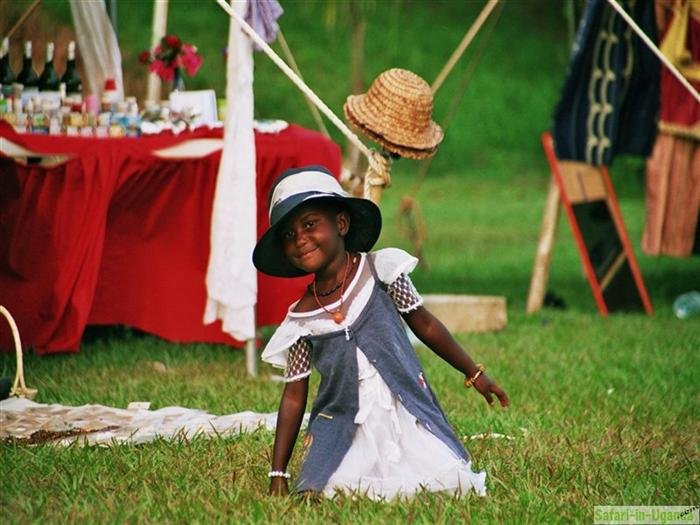 Uganda has no naturally grown population structure; rather, it is shaped by the influences of the colonial era. The borders do not follow ethnic groups; they were drawn more or less arbitrarily by the British. Today’s ethnic groups can be divided into four major groups:
- Bantu
- Nilotic peoples
- Pygmies
- Sudanese group
The largest group are the Bantu peoples, who live mainly in the southern half of the country. The Bantu have always been settled farmers and thereby promoted the formation of the kingdoms. In total 17 peoples belong to this group, of which the Baganda with 15.3 % of the total population, as well as the Banyankole (9.2 %), Basoga (8.1 %) and Bakiga (6.4 %), are the largest (2024 census).
Nilotic peoples originally come from the Nile region and are pastoral peoples. The most important representatives of this group live in Kenya: Maasai and Samburo. Sudanese peoples, by contrast, live in the western Nile area, while the Pygmies are found only very sporadically on the western border with the Congo. They are among the oldest still surviving indigenous peoples, and some of them still live as hunters and gatherers.
Further links
- Background information on the Bantu peoples in general, to the Baganda and the Bakiga
- Background information on the Nilotic peoples
- Background information on the Pygmies