
Start › Land & People: Uganda Country Information › Uganda’s History and Politics: A Steep Rise › Uganda during the Colonial Era
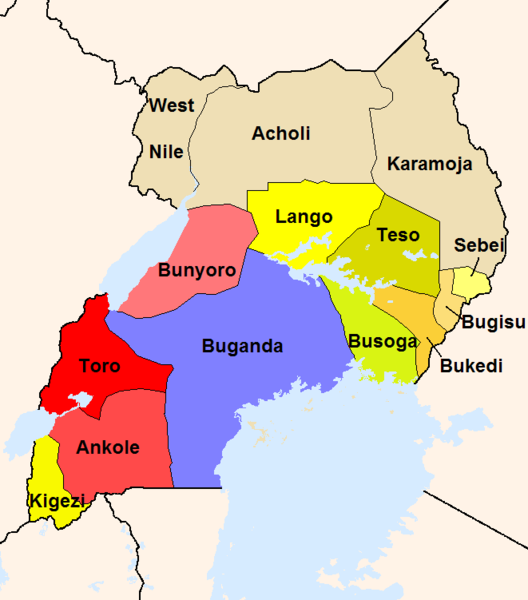 The kingdom that was by far the largest and most powerful immediately before colonisation was Buganda. The starting point of African colonisation was the Berlin “Congo Conference” 1884 under the leadership of Chancellor Bismarck, at which Africa was divided among the most powerful European states. Large parts of East Africa fell to Germany, but at the Heligoland-Zanzibar Conference the Germans were forced to cede their share to the British. The Kabaka (king) of Buganda did not agree with the annexation by the British, but – after fleeing and returning from exile – in the year 1893 had to sign a protectorate treaty.
The size of the British colony was constantly expanded and by the end of the 19th century included the former kingdoms of Buganda, Bunyoro, Ankole and Toro. In 1913 and 1914 the protectorate reached its maximum extent through the incorporation of Ancholi and Karamoja as well as the formerly Belgian West Nile Province.
The map shows the British administrative units of the Uganda Protectorate within the borders of 1926 (click to enlarge). The red and blue areas mark the former Buganda kingdom, in which the traditional kingdoms were retained. The yellowish areas mark regions in which the form of government and administration of the former Buganda kingdom (Kiganda system) was introduced. In the areas marked in khaki there was previously no independent traditional form of organisation (Source: WIKIPEDIA, A History of East Africa by Odhiambo, Ouso and Williams).
Further links
- Background information on the Congo Conference
- Background information on the Heligoland-Zanzibar Conference