
Start › Mountain Gorillas & More › Mountain Gorillas in Uganda
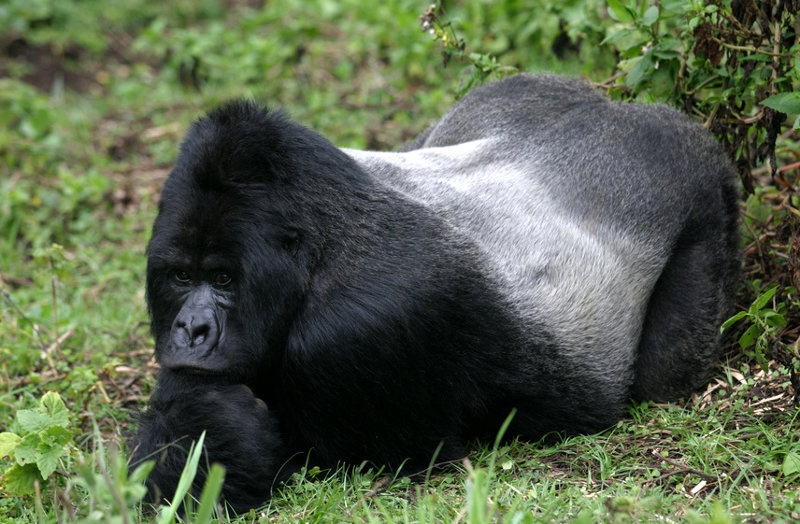 There are two subspecies of the eastern gorilla, one of which is the mountain gorilla (Gorilla beringei beringei). The gorillas are divided into two populations. One of them lives in Bwindi National Park in the south-west of Uganda. The other population lives in the Virunga volcanoes and is spread across three national parks:
- Mgahinga National Park in south-west Uganda
- Volcanoes National Park in north-west Rwanda
- Virunga National Park in the east of the Democratic Republic of the Congo
Adult mountain gorillas reach considerable dimensions: the males grow to just under 2 metres and their arms have a span of up to 2.3 metres. Their weight is up to 220 kg. The females are considerably smaller and weigh around 100 kg.
The thicker coat of the mountain gorillas, compared with other ape species, enables them to live in the relatively cool mountain regions. Because of the grey-silver colour of the coat on the backs of the adult males they are called “silverbacks”. The hair is shorter at this point than on other parts of the body.
Gorillas spend most of their time on the ground. To reach food, however, they also climb trees. Their long arms, which are longer than their legs, help them here. Mountain gorillas are active in daylight from 6:00 in the morning until 18:00 in the evening, spending most of that time eating.
Mountain gorillas are herbivores and mainly prefer leaves, twigs and branches from more than 100 plant species. Tree bark, fruit, flowers and roots complete the diet. The males consume up to 30 kg, the females just under 20 kg per day.
To sleep, the gorillas build nests on the ground from plant material in the surroundings, and they build a new one every day.
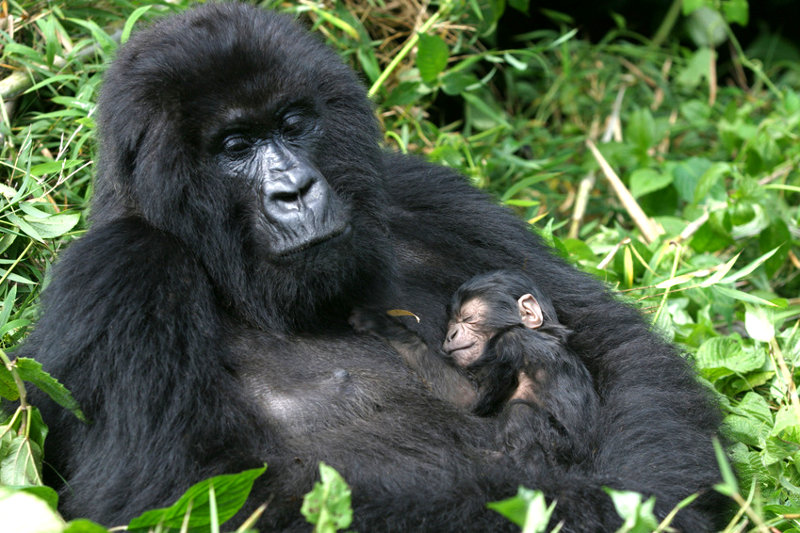 At birth mountain gorillas weigh no more than 2 kg. In the first months the newborns always stay with the mother, usually riding on her back. At around 5 months they also begin to walk. For the first 6 months they live exclusively on their mother’s milk, and then start to eat plants as well.
Mountain gorillas live together in groups of five to thirty individuals that roam through the forests. The leader of the group therefore does not defend a particular territory, but only his group. Usually the groups have only one silverback and a few younger male gorillas. The silverback decides where the group moves, he protects the group from dangers from outside and acts as a mediator in internal conflicts.
Gorilla safaris, gorilla trekking in Bwindi National Park
Bwindi National Park in Uganda is home to around 460 individuals, almost half of all the mountain gorillas living worldwide. For gorilla safaris there are now more than 20 gorilla families habituated to humans in Bwindi – and new ones are constantly being added. The allocation of the trekking groups is handled by the Uganda Wildlife Authority.
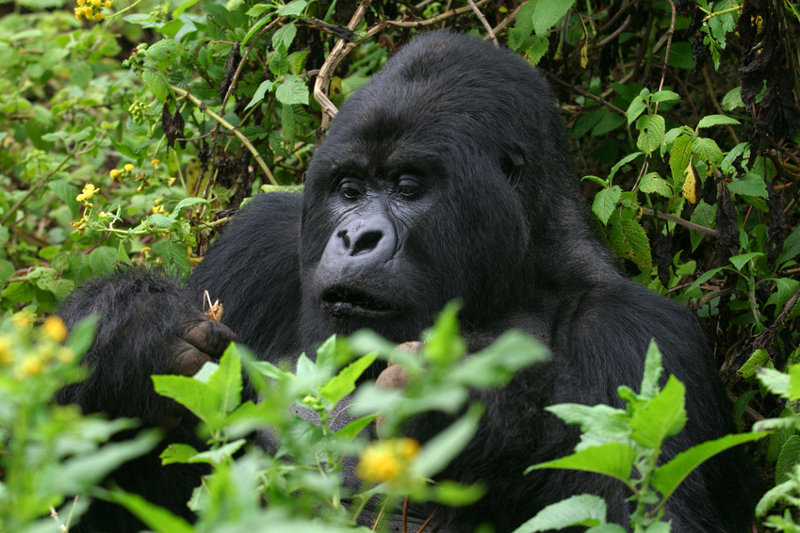 In order to protect the mountain gorillas, gorilla trekking is strictly limited and strict rules apply. For example, all tourists must be in perfect health. Because of the strict rules, you should apply for one of the sought-after permits at least 3 months in advance.
Gorilla trekking in Bwindi National Park means long, strenuous hikes right through the dense rainforest. You should therefore bring a good level of physical fitness. The excursions start at 8:30 in the morning. The equipment should definitely include:
- Trekking shoes and rainwear
- Sunscreen, hat, insect repellent
- Provisions for the hike
If you want to observe the mountain gorillas, strict rules must be observed:
- No one may enter the national park if they are ill (e.g. diarrhoea, a cold)
- The tourist group must always stay close together and a distance of at least 7 metres from the gorillas must be kept
- Flashes are not permitted
- Eating or smoking is not allowed near the gorillas; litter should generally be avoided.
For foreign tourists a permit (gorilla permit) currently costs 800 US dollars per person in the high season and 600 US dollars in the low season (April, May, November; as of 2026). It is only available from licensed tour operators. Further information and permits are available from the following addresses:
Uganda Wildlife Authority
Plot 7 Kira Road, Kamwokya
P.O. Box 3530 Kampala, Uganda
Tel: +256 414 355000 / +256 312 355000
Fax: +256 414 346291
Email: info@ugandawildlife.org
Web: www.ugandawildlife.org
or
Bwindi Impenetrable National Park
P.O. Box 862 Kabale, Uganda
Tel: +256-486-24121
Email: gorilla.bmca@ugandawildlife.org,
Web: www.ugandawildlife.org
or
Uganda Tourist Board
Impala House, Kimathi Avenue,
P.O. Box 7211, Kampala Uganda
Tel: +256-41-342196/7 Fax: 256-41-342188
Email: utb@starcom.co.ug,
Web: www.visituganda.com
You are currently viewing a placeholder content from Default. To access the actual content, click the button below. Please note that doing so will share data with third-party providers.